Full Analysis of 6 Main Injection Molding Materials including ABS & PC: Master Material Selection from 4 Dimensions!
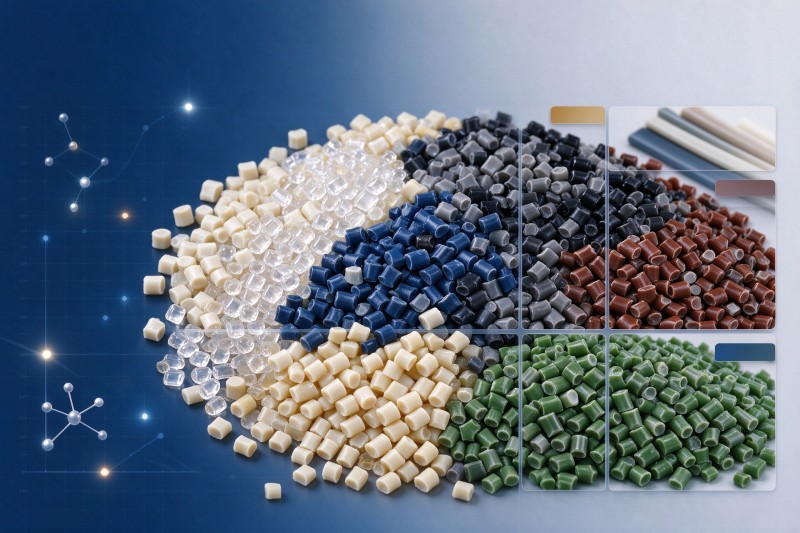
This article introduces six mainstream injection molding engineering plastics: ABS, PC, PVC, PA (Nylon), PMMA and PS. You can quickly master material selection knowledge from four dimensions: basic introduction, material performance, injection molding parameters and processing notes.
1. ABS
Material Overview
ABS is one of the most widely used engineering plastics. It is copolymerized of Acrylonitrile (A), Butadiene (B) and Styrene (S). Thanks to balanced comprehensive performance, it can be modified by blending with other plastics or additives to form multiple grades, such as impact-resistant grade, heat-resistant grade, flame-retardant grade, transparent grade, reinforced grade and electroplating grade.
The melt fluidity of ABS sits between PS and PC. Both melt temperature and injection pressure affect its flow behavior, while injection pressure has a greater impact. Higher injection pressure is usually adopted to reduce melt viscosity and improve filling performance.
Injection Molding Properties of ABS
General ABS melting point is around 170℃ and decomposition temperature is 260℃, with a wide adjustable molding temperature range. The typical processing temperature is 180~240℃.
Due to rubber phase component, ABS absorbs a small amount of moisture. Drying condition: 80~90℃ for 1~2 hours.
ABS has poor thermal stability and tends to degrade. Avoid long residence time of melt inside the barrel.
Its melt viscosity is higher than PS, yet normal gate and runner design can fill the cavity. ABS products are prone to static electricity and dust absorption.
Shrinkage rate: 5‰; Flash threshold: 0.05 mm.
2. PC (Polycarbonate)
Material Overview
PC features excellent performance and high transparency. It has high melt viscosity and poor fluidity, requiring high processing temperature (270~320℃). Its adjustable temperature window is narrower than PMMA, leading to higher processing difficulty.
Injection pressure has limited influence on fluidity. However, high viscosity requires relatively high injection pressure. To reduce internal stress, holding time should be kept as short as possible.
PC has relatively large shrinkage and high residual stress, which easily causes cracking. Improve fluidity by raising temperature rather than boosting pressure. Increase mold temperature, optimize mold structure and apply post-treatment to lower cracking risk.
Low injection speed tends to generate ripple defects near gates. Independent temperature control for nozzle, high mold temperature and low-resistance runners/gates are recommended.
Injection Molding Properties of PC
PC is amorphous plastic with no distinct melting point. Processing temperature: 250~320℃. PC absorbs moisture, and tiny water content causes thermal decomposition at high temperature, so full drying before molding is mandatory.
High melt viscosity requires high injection pressure. A mold temperature controller is recommended to reduce residual stress.
For parts with inserts: inserts under 1~2 mm diameter may skip preheating; larger inserts must be preheated to prevent stress cracking.
PC shrinkage barely relates to processing parameters or wall thickness. Longitudinal and transverse shrinkage are close, suitable for high-precision plastic components.
3. PVC (Polyvinyl Chloride)
Material Overview
PVC is a multi-component plastic. Commercial PVC pellets contain PVC resin powder plus additives: plasticizer for better fluidity, heat stabilizer for thermal stability, lubricant for mold release, together with fillers, colorants and coupling agents.
Different additive ratios produce PVC pellets of various hardness, measured by IP value. PVC is mainly divided into soft PVC and rigid PVC.
Injection Molding Properties of PVC
PVC absorbs slight moisture and drying is required before molding. PVC has no clear melting point. It may release hazardous gas during molding, so sufficient heat stabilizer must be added.
Processing principle: inject at low temperature and shorten cycle time to reduce melt residence time in barrel.
Long-term heating makes PVC turn yellow or produce black spots. Decomposed hydrogen chloride corrodes mold cavity. Regular cleaning for mold and dead corners is necessary.
Keep mold temperature low and shorten molding cycle. Gates and runners should be thick, short and wide to reduce pressure loss. High pressure & low temperature molding is preferred.
4. PA (Polyamide / Nylon)
Material Overview
PA, also called Nylon, refers to polyamide family. It contains amide groups and shares similar properties. It is tough, keratin-like, ranging from pale yellow translucent to opaque. Most Nylon is crystalline, while transparent amorphous Nylon is also available.
Commonly used for mechanical wear-resistant parts such as bearings, gears, wheels and rollers.
Injection Molding Properties of PA
The amide group leads to strong and stable water absorption. Thorough drying is required before molding.
PA has low melt viscosity and fast flow rate, which may cause nozzle drooling. Self-locking nozzle or special nylon nozzle is recommended, and high mold precision is required.
5. PMMA (Polymethyl Methacrylate)
Material Overview
PMMA, commonly known as acrylic, is colorless transparent pellet with specific gravity of 1.19. Finished parts show high surface gloss, hardness and rigidity.
Injection Molding Properties of PMMA
High melt viscosity and poor fluidity require high barrel temperature and high injection pressure. Melt temperature affects molding more than injection pressure, while higher injection pressure helps reduce shrinkage.
As an amorphous polymer without obvious melting point, PMMA has a wide molding temperature range. Raising melt temperature is the main method to improve fluidity.
PMMA has low impact resistance and poor wear resistance, easy to scratch or crack. Higher mold temperature and optimized cooling process can mitigate these weaknesses.
6. PS (Polystyrene)
Material Overview
PS has outstanding electrical insulation, especially high-frequency insulation. It is colorless and transparent, light transmittance second only to PMMA. It features good colorability, water resistance and chemical stability. Its strength is moderate, but brittle and easy to crack under stress. It is not resistant to organic solvents such as benzene and gasoline. It is widely used for transparent insulating parts, decorative components, chemical instruments and optical parts.
Injection Molding Properties of PS
PS is amorphous plastic with low moisture absorption. Deep drying is not required and decomposition rarely occurs. Its thermal expansion coefficient is high, easily causing internal stress. It has good fluidity; both screw and plunger injection machines are applicable.
Recommended process: high barrel temperature, high mold temperature, low injection pressure. Extending injection time helps reduce internal stress and prevent shrinkage and deformation.
Various gate designs are acceptable. Use arc transition between gate and product to avoid damage during gate trimming. Large draft angle and uniform ejection are required. Keep wall thickness uniform. Minimize inserts; preheat inserts if used.
Disclaimer
This article is sourced from other media and does not represent the views or positions of this website.
.jpg)