How to Select 10 Common Plastics: ABS to PET, Pros & Cons Explained
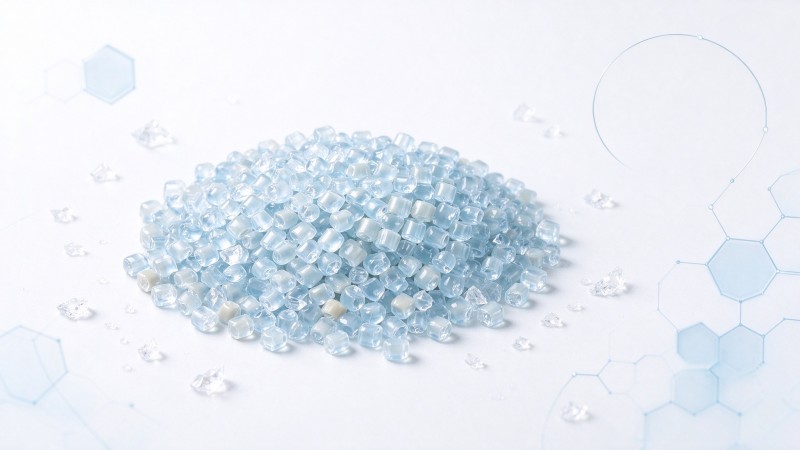
Core Principle
There is no best plastic, only the most suitable plastic. When customers request "the best material", it often means they lack clear requirements. Choosing expensive resin raises cost, while cheap grades risk underperformance.
| Material | Shrinkage (approx.) | Flowability | Heat Resistance (approx.) | Typical Weakness | One-sentence Positioning |
|---|---|---|---|---|---|
| ABS | 0.3-0.6% | Good | Around 80℃ | Poor weather resistance | All-purpose for housings |
| PC | 0.5-0.7% | Poor | Above 120℃ | Sensitive to internal stress | Transparent + impact resistant |
| PVC | 0.2-0.5% | Average | 65-80℃ | Poor thermal stability | Low cost, flexible or rigid |
| PA | 0.8-2.5% | Good | Above 100℃ | Dimensional change due to water absorption | Wear-resistant & self-lubricating |
| PMMA | 0.4-0.7% | Poor | Around 90℃ | Brittle, easy to scratch | High transparency, premium appearance |
| PP | 1.0-2.5% | Very good | Above 100℃ | Brittle at low temp, prone to shrinkage | Fold-resistant & fatigue-resistant |
| POM | 1.5-3.0% | Good | Above 100℃ | Prone to formaldehyde odor during decomposition | Hard & slippery, steel-like plastic |
| PS | 0.4-0.7% | Good | 70-80℃ | Brittle | Low-cost transparent, easy to crack |
| PE | 1.5-4.0% | Very good | 60-90℃ | Too soft | Soft, low-cost, chemical resistant |
| PET | 0.2-1.0% | Average | Above 120℃ | Difficult crystallization control | Tough, can be transparent |
Note: All data are empirical engineering ranges. Final values refer to supplier TDS. Verify before mold manufacturing.
Four Pre-selection Questions
Answer these four questions before checking datasheets:
1. Working environment: Indoor or outdoor? UV exposure? Determines weather resistance and temperature resistance.
2. Mechanical load: Cosmetic part or structural component? Load-bearing or repeated bending?
3. Visual requirement: Transparency, electroplating needed? Decides PC, PMMA or ABS.
4. Budget: Material share of total cost and customer budget.
Matching answers with reference table greatly improves selection accuracy.
| What You Need To Make | First Choice | Alternative | Reason |
|---|---|---|---|
| Home appliance housing, good-looking and low-cost | ABS | HIPS | Good moldability & painting performance, cost-controllable |
| Transparent parts with impact resistance | PC | PC+PMMA composite | Balances transparency and impact resistance when both cannot be fully achieved |
| Gears & sliders, wear-resistant and self-lubricating | POM | PA+Glass Fiber | Low friction coefficient, quiet operation |
| Snap fits & hinges, resistant to repeated bending | PP | PA | Excellent fatigue resistance, core advantage of PP |
| Outdoor equipment, anti-UV & anti-aging | ASA | PC/ASA | ASA has far superior weather resistance compared to ABS |
| Light guides & display panels, high light transmittance & good appearance | PMMA | PC | High light transmittance, not suitable for load-bearing |
Two Typical Pitfalls
1. PA (Nylon) is moisture-sensitive. Water absorption causes dimensional variation. Uncontrolled moisture leads to size drift in precision mating parts and jamming gears. Proper drying is mandatory.
2. POM releases irritating gas upon thermal decomposition. Its processing window is much narrower than ABS. Overheating in barrel causes safety risks and part defects.
Do you select resin based on calculation, or just habitual practice? Habitual selection saves meeting time but may erode profit.
Read TDS Properly
Property data is tested under standard specimen, temperature and speed. The same resin behaves differently in thin wall, thick wall, long flow path, ribbed or bossed designs. Combine material data with part geometry for engineering judgment.
| Physical Property Data | Implications for Structural Design | Additional Verification Required |
|---|---|---|
| Shrinkage Rate | Affects dimensions, fit and mold scaling | Mold trial measurement, retest after stabilization |
| Impact Strength | Affects drop and collision service life | Drop test on actual products |
| Heat Resistance | Affects long-term operating temperature | Temperature rise, aging and deformation tests |
| Water Absorption | Affects dimension and strength of materials such as PA | Comparison between dry and moisture-absorbed states |
| Flowability | Affects thin walls, long flow paths and gate selection | Filling, weld line and venting verification |
Overview of 10 Plastics
- - **ABS**: Balanced general-purpose housing resin. Not ideal for outdoor weathering or special flame retardancy without modification.
- - **PC**: Excellent impact resistance, transparency and heat resistance. Control melt flow, drying and internal stress.
- - **PVC**: Available in rigid & flexible grades. Thermal stability and formula matching are critical.
- - **PA**: Good wear resistance, self-lubrication and strength. Moisture absorption changes dimension and molding performance.
- - **PMMA**: High light transmittance for lighting & display. Vulnerable to scratch, cracking and residual stress.
- - **PP**: Suitable for repeated bending and fatigue applications. Control shrinkage and warpage.
- - **POM**: Ideal for gears, sliders and wear-resistant parts. Strictly limit processing temperature and residence time.
- - **PS**: Low cost and easy molding. Not recommended for high-impact scenarios.
- - **PE**: Lightweight, flexible and chemical-resistant, with limited rigidity.
- - **PET**: Strong and transparent. Focus on crystallization and process stability during molding.
Filter Materials by Requirements
Split requirements into three columns for review meetings:
1. Non-negotiable: Safety, strength, temperature resistance, transparency, service life.
2. Optimizable: Color, gloss, local hand feel.
3. Constraints: Cost and supply chain.
This framework helps balance conflicting demands like low cost plus maximum performance.
| Review Sequence | Questions to Answer | Output Result |
|---|---|---|
| Working Condition | What are the temperature, humidity, impact, friction and chemical contact requirements | Material application boundary |
| Appearance | What are the requirements for transparency, gloss, texture, painting and electroplating | Surface treatment boundary |
| Structure | How to design wall thickness, ribs, bosses, snaps and fits | List of molding challenges |
| Production | How about supplier, equipment, cycle time and testing capability | Mass production feasibility |
| Verification | Which dimensions, appearance and service life items must be tested | Test plan |
Material selection does not end at table lookup, but starts validation. Re-evaluate dimension and appearance when resin grade, color, filler loading or surface treatment changes. A replicable production solution must trace from requirements, resin grade, process, samples to mass production records.
Conclusion
Plastic selection is about matching material properties to real working conditions. Avoid choosing resin only by experience. Clarify hard requirements, watch out for typical processing risks and validate samples before mass production.
Disclaimer
This article is sourced from other media and does not represent the views or positions of this website.