
How to Choose Between TPU and TPE, Both Thermoplastic Elastomers?
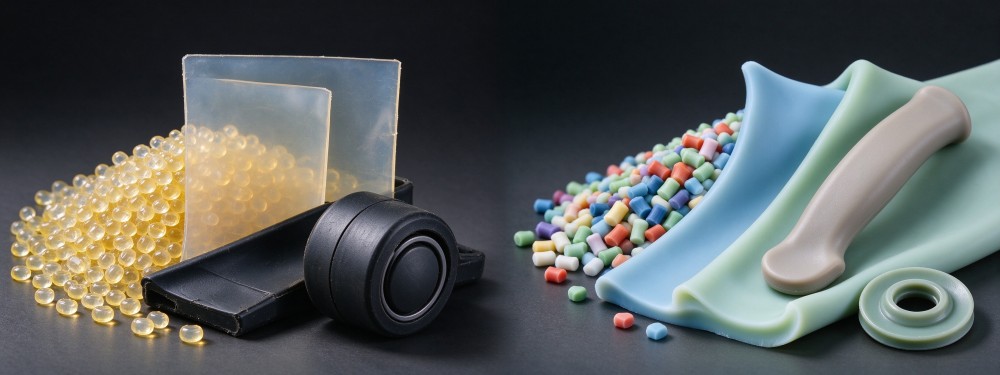
When people ask how to choose between TPU and TPE, they are actually asking the wrong question.
They are not two candidates competing for the same job; they are designed for different roles.
It is impossible to simply say which one is better.
The key depends on the working environment of your finished product.
This article helps you clearly distinguish them.
01 Clarify the relationship between the category and the specific material
Before discussing TPU and TPE, we need to sort out their relationship first.
TPE is the name of the whole family — the general term for all thermoplastic elastomers.
TPU is one member of this family, known as thermoplastic polyurethane.
For analogy: TPE is like the broad category "fruit", while TPU is a specific type such as "apple".
Asking "which is better, TPE or TPU" is just like asking "which is better, fruit or apple", which is logically confusing.
The right question should be: For my soft rubber parts, do I need wear resistance, oil resistance or high elasticity? Which material fits this working condition best?
02 Advantages of TPU and TPE respectively
Within the TPE family, TPU is the heavy-duty option — tough, compression-resistant, good in resilience, excellent in wear, oil and hydrolysis resistance. It performs exceptionally well at hardness above 80A. Its strengths include load-bearing, tear resistance and resistance to repeated bending.
TPE (SEBS/SBS-based) is more like a soft slipper — soft touch, easy to process and cost-effective.
It is ideal for hand-feel parts, consumer goods and children’s toys. However, it is weaker in oil resistance, wear resistance and temperature resistance. Its mechanical strength drops sharply when formulated to extra soft grades.
In short:
- - At the same hardness, TPU has better strength, oil resistance and wear resistance
- - TPU is an engineering-grade material for mechanical performance
- - TPE is a consumer-grade material focused on soft touch and cost control
- Both belong to the TPE family. Neither is universally superior. They serve different application scenarios.
03 Scenarios where TPU is preferred — 4 types of high-strength working conditions
High wear resistance: shoe soles, conveyor belts, automotive chassis sheaths, luggage rollers. TPU ranks top in wear resistance among elastomers.
High oil resistance: industrial hoses, mechanical seals, oil circuit sheaths. TPU will not swell or degrade when exposed to oil.
High hydrolysis resistance: outdoor cables, medical catheters, diving equipment. TPU has stable hydrolysis resistance.
High elastic memory: fitness equipment, robot joints, tendon cords for dexterous grippers. TPU recovers quickly after deformation with low permanent deformation.
Products made of TPU can serve for years under these conditions, while TPE may fail within months.
04 Scenarios where TPE is recommended — 3 scenarios prioritizing soft touch and cost
Consumer goods requiring soft touch: toothbrush grips, children’s toys, handles, massage equipment. TPE delivers comfortable touch and abundant color options.
Single-use or low-load products: disposable gloves, sealing gaskets, low-load protective sleeves. TPE is low-cost and easy to process.
Overmolding with PP/PE: good compatibility and mature production process.
Using TPU for these applications is overkill. You pay extra for mechanical properties you will never use.
05 How to choose for borderline scenarios
Some applications need neither extreme wear resistance nor only soft touch. Judge from three dimensions:
Hardness: TPU is commonly available in 80A-95A; TPE can reach below 20A for ultra-soft grades.
Temperature range: TPU works long-term at -40℃~80℃; most TPE grades are for -30℃~70℃.
Exposure to oil, water or chemicals: TPU wins here.
After checking these three points, you can decide whether TPU or TPE fits your project.
If you still feel confused, ask your supplier for datasheets or professional recommendations.
06 Selection summary
When choosing between TPU and TPE, focus on application requirements instead of picking one blindly:
Choose TPU for high mechanical performance requirements
Choose TPE if soft touch and low cost are the priority
For borderline cases, refer to material datasheets
Next time someone asks which one is better between TPU and TPE,
you can reply with a question: What product are you making and what environment will it work in?
Both materials are stocked at Yonghesheng. If you have material demands, we have many grades for your selection. Leave a message telling us your product information. Whether you are developing new products or looking for cost-saving alternatives, we can match the most suitable grade for you. Samples are available for trial after grade confirmation.
Yonghesheng is not just a material supplier. We provide integrated materials and technical services. We track the whole process from sample testing to mass production. We help optimize molding parameters according to material properties. Our technical team can offer on-site guidance for processing issues.
Disclaimer
This article is sourced from other media and does not represent the views or positions of this website.