
TPEE vs TPC: Structure, Classification & Material Selection Guide
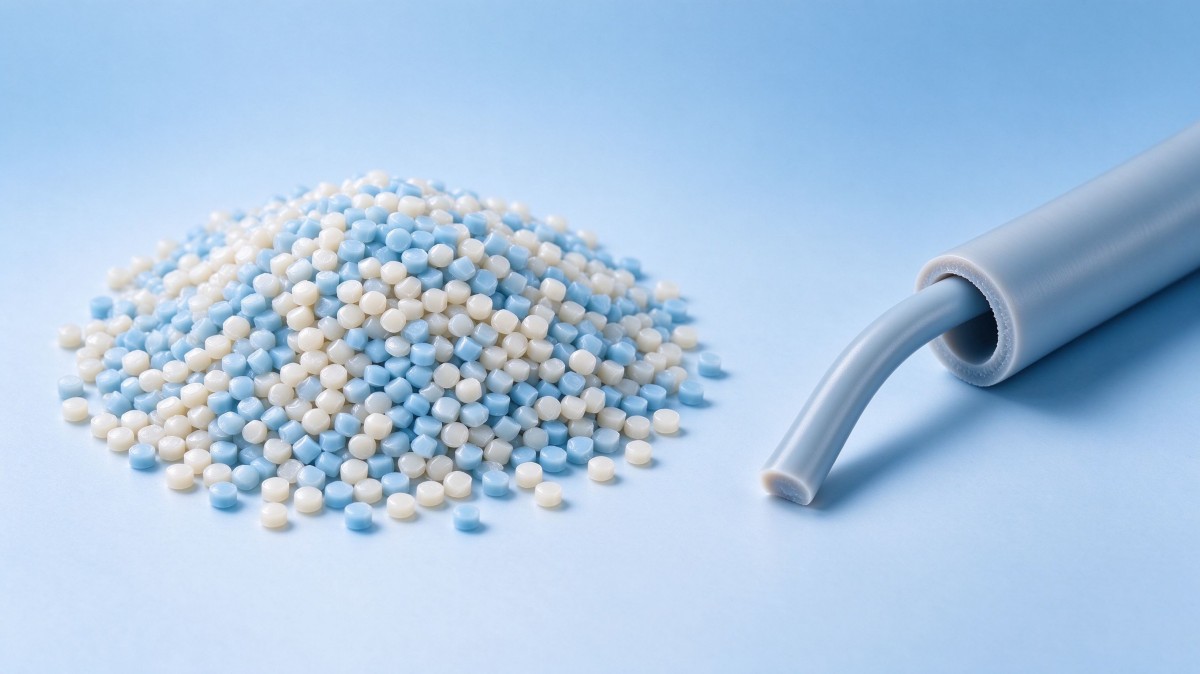
What is the relationship between TPEE and TPC? Structure determines performance.
When purchasing TPEE, you may find some datasheets marked TPC and some marked TPC-ET. These abbreviations do not represent performance rankings. Starting from ISO standards, we explain the hard and soft segment structure of copolyester elastomers, the differences among four types of soft segments, and the source of elasticity and thermoplastic processability. Taking flexible corrugated tubes as an example, we illustrate the conditions to check for repeated bending, long-term deformation, medium contact and blow molding. Do not select materials only by abbreviations. Check specific grades, test conditions and product working conditions. When selecting materials, do you often encounter mixed names or incomplete performance data?
TPEE vs TPC
Common industry name: TPEE / TPE-E, Thermoplastic Polyester Elastomer
Standard category code: TPC, Thermoplastic Copolyester Elastomer, ISO 18064:2022
They belong to the same material family.
Same name category does not mean identical grades.
Product Grade Information Card: Grade, Manufacturer, Product Series...
Actual performance shall be verified against the complete grade datasheet.
Why Are There Four Classifications of TPC?
Classification basis: Chemical structure of soft segments
Hard segment (contains ester bond structure)
- - TPC-ET: Polyether soft segment, dominated by ether bonds, polyether structure.
- - TPC-ES: Polyester soft segment, dominated by ester bonds, polyester structure.
- - TPC-EE: Soft segment with both ether and ester bonds, composite structure.
- - TPC-CE: Polycarbonate soft segment, dominated by carbonate bonds, polycarbonate structure
The hard segment features ester bond structure.
Different classifications do NOT represent performance ranking.
Reference standard: ISO 18064:2022
Why Does TPEE Combine High Strength and Elasticity?
Typical polyether-ester type TPC
Crystalline polyester hard segment: forms physical constraints
Flexible polyether soft segment: enables deformation and recovery
Enlarged local analysis
- - Hard segment: forms ordered crystalline aggregation zones, acting as physical constraints to deliver strength and dimensional stability.
- - Soft segment: flexible chain with variable conformation; it stretches under load and recovers after unloading to endow elasticity.
The synergistic effect of hard and soft segments determines material performance.
Concept diagram, not micrograph test result. Actual performance depends on grade and working conditions.
Why Is Elastic TPEE Suitable for Melt Processing?
Service condition: Within proper temperature and deformation range, copolyester elastomer achieves reversible elastic deformation via its hard/soft segment structure.
Original state → Controlled stretched state (elastic deformation) → Recovery after unloading (mostly restored)
Physical constraints of hard segments support elastic performance
Same material: TPEE / TPC (copolyester elastomer)
- Low temperature range (service condition): elastic deformation and recovery
- High temperature range (heating for processing): plasticized and shaped
Heating processing: With proper heating, the physical constraints of hard segments are weakened or partially eliminated. The material turns into molten flow state for thermoplastic forming.
Elastic recovery and melt processing are two distinct states.
The actual temperature window varies by specific grade.
Why Does TPC Corrugated Tube Suffer from Bending Fatigue?
Straight state / Bending state
When bent: outer side stretched, inner side compressed
Enlarged view: crest, trough, local wall thickness
Repeated deformation leads to local strain.
Fatigue life is related to material, structure and working conditions.
Structural deformation diagram, not simulation result.
Good Rebound = Durable and Oil Resistant?
Short-term elastic recovery: focus on recovery after unloading
Long-term load: focus on creep and permanent deformation
Medium exposure: focus on medium type, temperature and duration
Check: medium type, temperature, contact time, property changes (appearance / mechanical properties etc.)
These three properties cannot replace each other.
Evaluation shall be based on specific grade and test conditions.
Test setup diagram, not actual test result.
Can TPC Corrugated Tubes Be Directly Blow Molded?
Process flow:
1. Melt extrusion: Plasticize TPC and extrude parison
2. Mold forming: Close mold and pressurize to fit parison into corrugated cavity
3. Cooling setting: Cool inside mold to stabilize corrugated structure
4. Demolding: Open mold and take out hollow corrugated tube
Comprehensive evaluation for molding adaptability:
✅ Melt performance (melt strength, stability)
✅ Mold design (corrugation geometry, cavity matching)
✅ Wall thickness control (uniformity)
✅ Actual processing parameters (extrusion, forming, cooling cycle)
Focus on melt adaptability and wall thickness uniformity.
Not all grades of this material category are suitable for blow molding.
Blow molding principle diagram.
How to Choose Between TPEE and TPC?
1. Clarify actual working conditions: temperature, medium (oil, solvent etc.), bending (frequency & amplitude), sealing requirement
2. Check complete material grade: confirm grade, review key TDS data, verify matching between test conditions and application
3. Sample validation: molding adaptability (extrusion, blow molding etc.), product performance test (bending, sealing, medium resistance etc.)
If basic requirements are not met → reselect material; if met → proceed to validation
4. Final selection: confirm suitability based on validation results
Material abbreviation alone cannot replace engineering verification.
Disclaimer
This article is sourced from other media and does not represent the views or positions of this website.