
Technical Specifications
Typical physical property data, subject to batch test reports.
| Category | Name of indicators | Unit | PVDF | Test Methods | Remarks |
|---|---|---|---|---|---|
| Physical Properties | Relative density | g/cm³ | 1.75-1.79 | ASTM D792 | |
| Physical Properties | Melt flow rate | g/10min | 15 | ASTM D1238 | Custom-available |
| Physical Properties | Melting point | ℃ | 155-175 | GB/T 16582 | |
| Mechanical Properties | Tensile strength | MPa | ≥35 | ASTM D638 | pre-irradiation |
| Mechanical Properties | Tensile strength | MPa | ≥30 | ASTM D638 | post-irradiation |
| Mechanical Properties | Elongation at break | % | ≥300 | ASTM D638 | pre-irradiation |
| Mechanical Properties | Elongation at break | % | ≥150 | ASTM D638 | post-irradiation |
| Mechanical Properties | Hardness | Shore hardness | 70-80 | ASTM D2240 | |
| Mechanical Properties | Dynamic friction coefficient | —— | 0.33 | GB/T 10006 | |
| Mechanical Properties | Elongation at break | % | ≥125 | ASTM D638 | 200℃/168H |
| Thermal Properties | Maximal Temperature of | ℃ | 150 | - | post-irradiation |
| Thermal Properties | Heat distortion temperature | ℃ (1.82MPa) | 48 | GB/T 19466 | |
| Thermal Properties | Thermal expansion Coefficient | 10⁻⁵/℃ | 7-14 | ASTM D 696 | |
| Thermal Properties | Low Temp Flexibility | ℃ | -55 No cracking | ASTM D 2671 C | |
| Thermal Properties | Thermal Shock | / | No cracking | ASTM D 2671 | 250℃,4h |
| Electrical Properties | Volume resistivity | Ω.cm | ≥10¹¹ | ASTM D 257 | |
| Electrical Properties | Dielectric Strength | kV/mm | ≥15 | DIN EN 60243-1 | |
| Electrical Properties | Relative dielectric Constant | 10³Hz | 7 | ASTM D150 | |
| Electrical Properties | Dissipation Factor | 10⁶Hz | <0.17 | ASTM D150 | |
| Burning Properties | LOI | % | 42 | ASTM D 2863 A | |
| Burning Properties | Flammability Rating | / | V-0 | UL94 |
Extrusion Process
Cross-linked PVDF can be fabricated via conventional thermoplastic processing techniques such as compression molding and extrusion. Thanks to the resin’s high critical shear rate, high extrusion speeds are achievable prior to melt fracture, allowing the material to be extruded into thin-wall components. All wetted parts of the extruder in contact with the resin, including the screw, barrel and die, shall be made of corrosion-resistant metal.
Fluoroplastics require comparatively high processing temperatures. To achieve full plasticization without degrading resin properties, the processing temperature, residence time and shear rate must be precisely controlled. An excessively low screw length-to-diameter ratio (L/D) may lead to incomplete plasticization, whereas an overly large L/D will prolong material residence time and potentially trigger thermal decomposition. A screw L/D ratio of 22:1 25:1 is recommended for this product.
The recommended irradiation dose for irradiation crosslinked PVDF insulating compound is 6 15 Mrad (Megarad).
| Processing Methods | Rear/℃ | Middle Section/℃ | Front Section/℃ | Head/℃ | Extrusion Tooling/℃ |
|---|---|---|---|---|---|
| Extrusion Molding | 160-180 | 190-210 | 190-220 | 210-240 | 210-240 |
Recommended Processing Parameters
Properties
- Cross linked PVDF boasts excellent properties including low specific gravity, good mechanical performance, aging resistance, radiation resistance and resistance to various chemical solvents. It can be used as insulation material for aerospace cables and applied in harsh environment occasions with high temperature requirements, such as nuclear power, military industry, automobiles, locomotives and petroleum mines.
Packaging
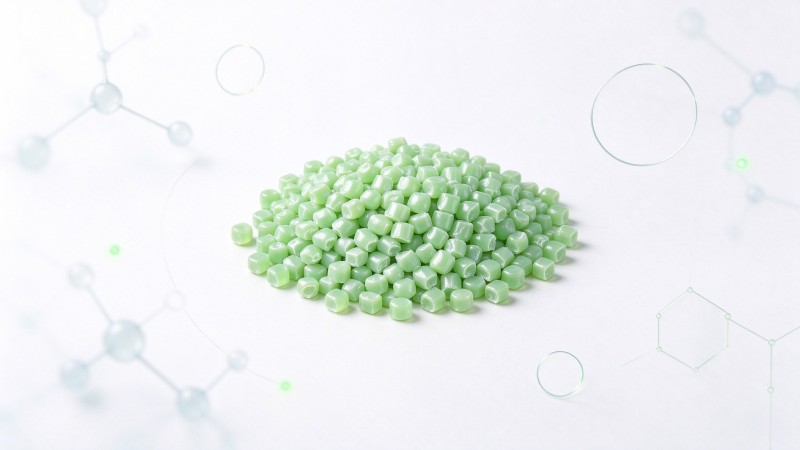
- Cross linked PVDF appears as cylindrical pellets. It is packed in double layer plastic bags with a packaging specification of 25 kg per bag.
Storage and Handling
- Cross linked PVDF resin is not affected by storage time. Once the package is opened, the pellets shall be protected against moisture absorption and contamination from the external environment. All processing equipment for this product must be thoroughly cleaned with no residual materials left inside.
Safety Precautions
- When the processing temperature of PVDF resin exceeds 350 °C, a small amount of decomposition by products will be released. These decomposition products may be hazardous to human health, and inhalation of the evolved gases must be avoided. Therefore, adequate ventilation shall be provided for the extruder, processing equipment and working area.