
Eight "Top Plastics"! Material Hidden Tech in Daily Life
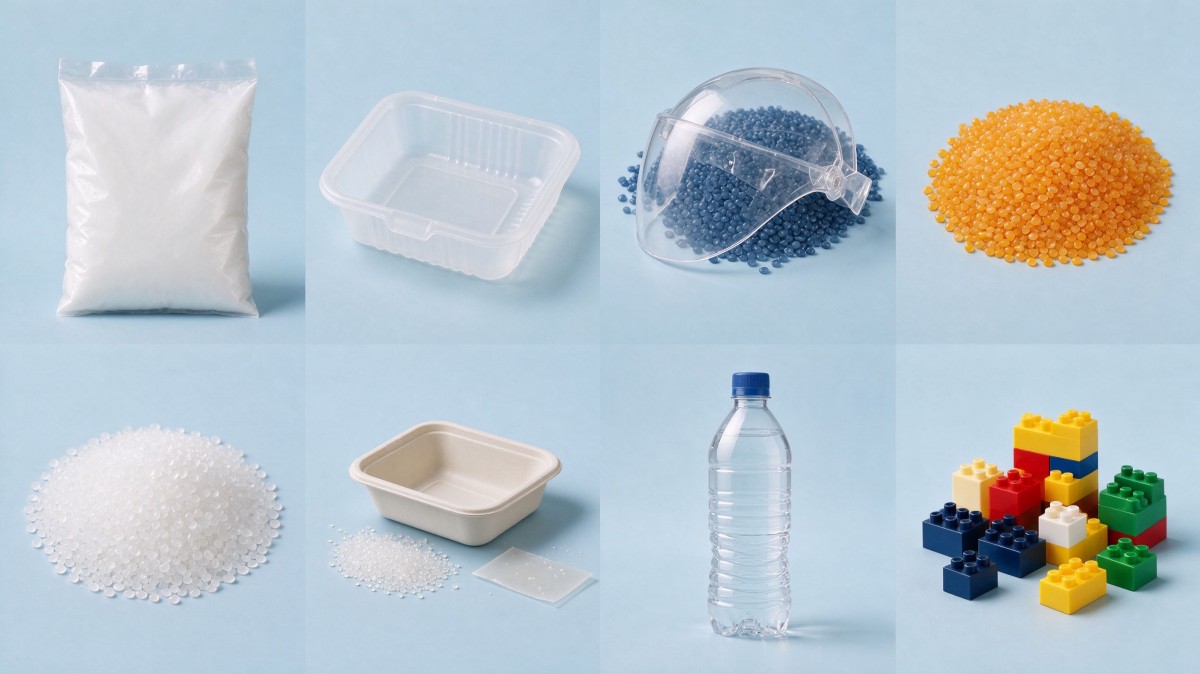
When talking about plastics, most people think they are cheap, lightweight and everywhere.
But few people know that the plastic family includes many "extreme performers". Some are soft as cotton, some as hard as steel, some biodegradable, and others high temperature and corrosion resistant.
These top-performing plastics have been widely used in daily life, medical treatment, industry and high-tech fields, becoming essential basic materials for modern society.
Today we will introduce 8 practical top plastics, their features, applications and new trends of the plastic industry.
1. Most versatile & affordable: PE (Polyethylene) — All-purpose plastic
PE is the most productive and widely used general plastic worldwide.
It is lightweight, non-toxic, waterproof, chemically stable, low-cost and tough. It performs stably under low freezing and normal temperatures.
It can be seen everywhere: shopping bags, food wrap, food containers, buckets, water pipes and detergent bottles. LDPE is soft for films; HDPE is harder for rigid containers and pipes.
2. Best heat-resistant food-grade plastic: PP (Polypropylene)
PP stands out among general plastics.
It can withstand temperatures above 100°C for microwave heating, with good acid & alkali resistance and low risk of harmful substance precipitation. It features excellent hinge toughness and resists cracking after repeated bending.
Typical uses: microwave containers, baby bottles, straws, bottle caps, automotive interiors and appliance parts.
3. Highest impact resistance: PC (Polycarbonate) — Shatterproof transparent material
PC has outstanding impact resistance, around 250 times stronger than ordinary glass. It is highly transparent, heat-resistant and flame retardant. It will not splatter into sharp fragments when hit hard.
Common applications: safety helmets, goggles, high-end water cups, phone housings, bulletproof glass interlayers and precision equipment shells.
4. Softest elastic plastic: TPE (Thermoplastic Elastomer)
Many soft products are made of TPE instead of silicone.
TPE combines rubber-like elasticity and plastic processability. It is skin-friendly, stretchable, non-toxic, anti-slip and wear-resistant.
Applications: phone soft cases, cable jackets, sealing strips, medical tubes, kids toys, anti-slip grips and yoga mats. It is recyclable and easier to process than traditional rubber.
5. Most readily biodegradable: PLA (Polylactic Acid) — Eco-friendly plastic
PLA is the most mature biodegradable plastic. It is made from renewable plant starch like corn and cassava. Under composting conditions, it fully decomposes into CO₂ and water in about 180 days with no residue.
It is hard, transparent and safe for food contact. Widely used for disposable tableware, straws, food packaging and agricultural films.
6. Most corrosion-resistant & insulating: PTFE (Polytetrafluoroethylene) — King of Plastics
PTFE is known as the King of Plastics for its superior stability.
It resists strong acids, alkalis and solvents, works stably from -200°C to 260°C, with excellent insulation and non-stick surface.
It is used for non-stick pan coatings, anti-corrosion pipes, electronic insulation parts, aerospace components and lab equipment.
7. Lightweight transparent packaging plastic: PET (Polyethylene Terephthalate)
PET is the preferred transparent packaging material. It is rigid, transparent, good at gas barrier and oxidation resistance, lightweight and pressure-resistant.
Typical products: mineral water bottles, beverage bottles, cosmetic containers, food packaging and blister packs. Note: it cannot withstand high temperature and is not suitable for repeated heating.
8. Best balanced cost-performance: ABS — Universal engineering substrate
ABS is a versatile engineering plastic with balanced performance: high hardness, good toughness, wear resistance, easy coloring and molding at a friendly price.
Applications: keyboard shells, suitcases, home appliance housings, building blocks, auto parts and children’s toys.
Future Trends of Plastic Industry
Plastics are no longer cheap disposable materials. The whole industry is upgrading in three directions:
1. Eco-friendly development: Biodegradable and recycled plastics gain larger market share under global plastic restriction policies.
2. High-end functionalization: High-performance modified and engineering plastics are increasingly adopted for new energy, automotive, aerospace and medical sectors.
3. Strict safety standards: Food-contact and medical-grade plastics require non-toxic, low-precipitation and stable formulas.
Closing
From soft TPE to impact-resistant PC, eco-friendly PLA and versatile ABS, each plastic has its own exclusive application field.
They are inconspicuous yet indispensable for convenient, safe modern life.
In the future, plastics will become eco-friendly, multi-functional advanced materials to empower daily life and industrial development.
Disclaimer
This article is sourced from other media and does not represent the views or positions of this website.


.jpg)
.jpg)
.jpg)
.jpg)